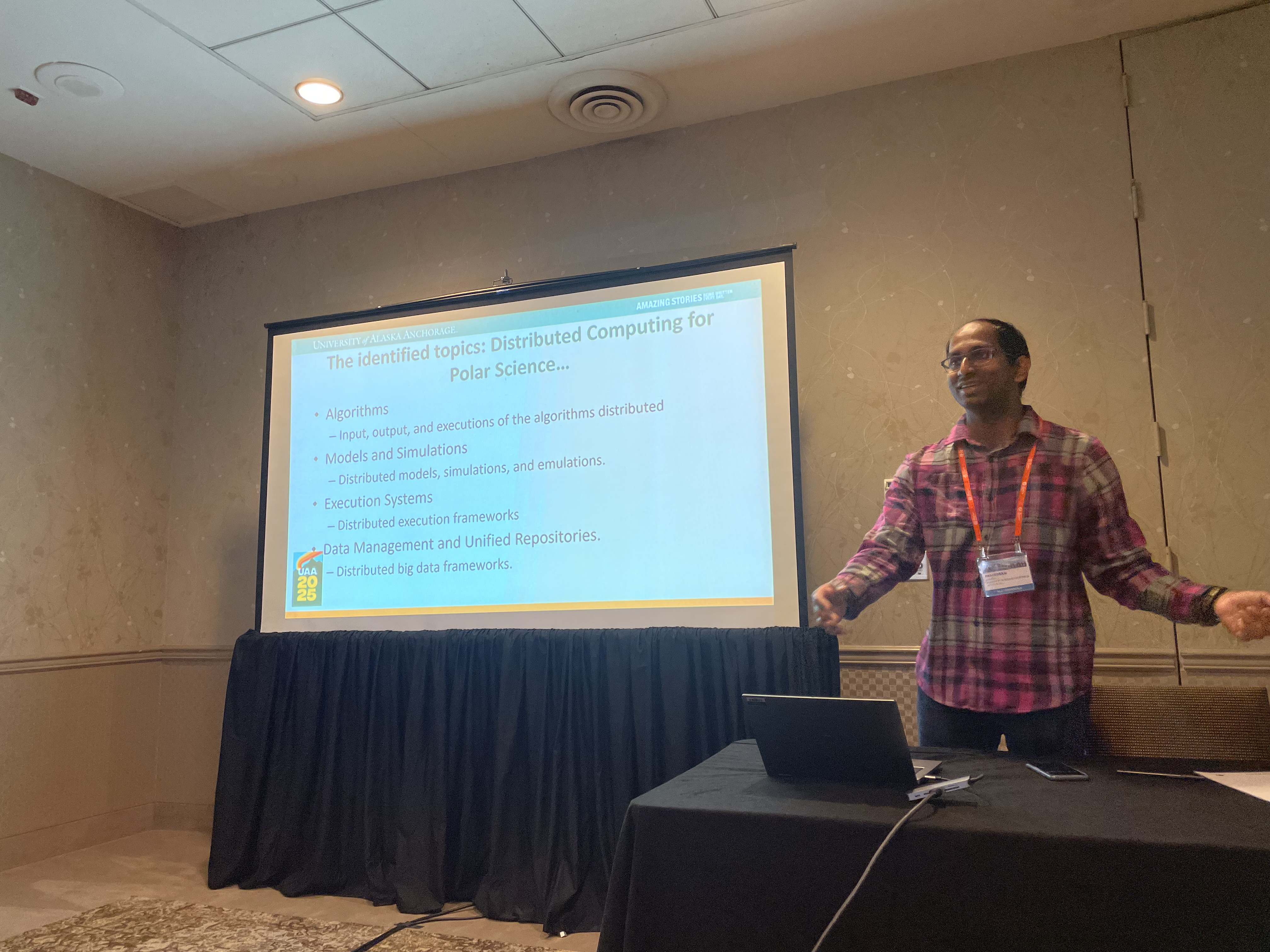
![]() |
| Presenting at the CCGrid QUICK workshop |
Thursday, December 26, 2024
Conferences and friends
Wednesday, December 11, 2024
Country #50, Continent #5
![]() |
| Cute views of Melbourne |
Melbourne was nice with its bathing boxes in Brighton beach and kangaroo meat. But hitting the magic number 50 in visited countries made it feel like an achievement on its own. Now, waiting for the country #51. This was also the year where I visited most continents in a single year: North America, South America, Asia, and Australia.
Wednesday, December 4, 2024
Nunaliit on Ubuntu 24.04
![]() |
| CouchDB configured on Ubuntu 24.04 |
![]() |
| Nunaliit on Ubuntu 24.04 |
Thursday, November 28, 2024
Be intentional when you contact a faculty for grad school
(*some really high unrealistic number!)
"Yes, I did. I spent a day drafting that email." Remember these are often not native English speakers. So, drafting that email can be intimidating. They can be intimidating to even native speakers.
"Can I see?"
"Sure."
"Ok, that is a well-written email. But you did not make a connection to why this university and why this professor. The email looks too random and not directed to this professor."
"Oh, I see."
"Can I see another email?" "
"Another email?"
"I mean, one you have sent to another professor?"
"Ok, here!"
"It is the same email!"
"No, I changed their name."
Now, you see the problem. They drafted one careful email. Sure, they spent one whole day drafting it. But then to send them to each individual faculty in different universities in different countries: all they did was merely changing the name in the "Dear Dr. ____"
Why should I reply to an email that was actually sent to 260 people? Some do not even bother to change the name. So, they make it easy by just sending "Dear Professor," I mean, "Dear Professor" is great. But the email should specifically say why you contacted me rather than an email that could be sent to other thousands of people.
In the era of ChatGPT, drafting these emails also do not take one whole day anymore. I receive many emails from students which I sense written by or with the help of ChatGPT. That is okay. But why should a professor reply to an email that was too generic? Same goes to employers too.
Sometimes I receive somewhat personalized email, but obviously phrases copy-pasted from my profile, even showing different fonts. For example, "I contact you because I share the same research interests as you: Distributed Computing, Wide Area Networks, Middleware, Telehealth, Circumpolar North.
I mean, if you really have that perfect overlap, your CV, experience, and email should reflect it more, rather than giving an impression it was copy-pasted from Google Scholar (because it was!).
Now, students complain, why should I waste an hour to send an email to a professor who would anyway ignore it. This is because you have already assumed they will ignore. In that case, there is no need to send at all, rather than doing a Russian Roulette of doing a numbers game and throwing arrows everywhere hoping at least one would land.
So, what should I do?
Consider an email as the first meeting. Find the professors and universities that you really like to work with. Be honest with yourself in the email. Do you really like all these research fields or are you just open to any field. Maybe skim through a few recent papers of the professor and their research team. Anything impresses you? No? Then probably better not to send that email at all. Yes? Maybe read more. In your email, mention what you liked about their research. Do you specifically like their university or city for whatever reasons? You can mention too. Spend an hour drafting each email individually and personally, rather than spending a whole day drafting a "perfect" email which you then mindlessly send to 260 people with no change except for name and email address.
I always want to reply to all the emails I get from students all over the world. But I also notice they were just sending as a mass emailing scheme. In the rare case I reply, those students do not even bother to reply back.
When I was a student sending such emails, my emails never got ignored. Because, those were intentional and carefully and personally written. So, focus on quality vs. quantity when you reach out to faculty for your grad school.
Good luck.
Thursday, October 10, 2024
Ditt KTH-konto kommer att deaktiveras / Your KTH account will be deactivated
INFORMATION IN ENGLISH FURTHER DOWN
Detta meddelande går till dig som har ett KTH-konto men ej är anställd eller studerar på KTH.
Då KTH-konton är avsedda för de som för närvarande studerar eller arbetar på KTH kommer ditt konto att deaktiveras den 12 november 2024. Detta görs av såväl säkerhets- som resursskäl.
Det innebär att:
Du inte kommer att kunna logga in på ditt konto
E-postadressen kopplad till kontot kommer att sluta fungera
Eventuell automatisk vidarebefordran av e-post kommer att upphöra
Om det finns filer, e-post eller annan information som du vill ha
kvar måste du själv flytta eller kopiera dem till din privata dator. De
kommer inte att kunna återfås efter deaktiveringen av KTH-kontot.
Om du har behov av KTH-konto på grund av pågående arbete på/med KTH kontakta din uppdragsgivare som gör en bedömning och beslutar om en eventuell förlängning av kontot.
Informationen finns även publicerad på KTH:s webbplats:
Deaktivering av e-post och KTH-konto för studenter | Student
Deaktivering av e-post och KTH-konto för anställda | KTH Intranät
Registrera dig till KTH:s alumnnätverket med din privat e-postadress
Med vänlig hälsning
KTH:s IT-avdelning
KTH:s säkerhetsavdelning
INFORMATION IN ENGLISH
This message is for those with a KTH account but not currently employed or studying at KTH.
Your KTH account will be deactivated on 12 November 2024 as KTH accounts are intended for those studying or working at KTH. This is done for both security and resource allocation reasons.
This means that:
It will not be possible for you to log in to your KTH account
The email address associated with the account will stop working
Any automatic e-mail forwarding will also stop working
If there are files, e-mails, or other information on the account that you want to keep, you will have to move or copy them to your own computer yourself. It will not be possible to retrieve them after deactivation of your KTH account.
If you need a KTH account due to ongoing work at/with KTH, contact your responsible manager/equivalent who will assess and decide on the need for an extension of your KTH account.
This information is also published on the KTH website:
Student web: Deactivation of e-mail and KTH account for students | Student
KTH intranet: Deactivation of e-mail and KTH account for employees | KTH Intranet
KTH Alumni: Register to the KTH Alumni Network by using your private email
Sincerely
KTH IT Department
KTH Security and Safety Department
![]() |
| My KTH Profile |
This is sad. I like my KTH email address. It is short and sweet - kpr@kth.se. So, even though my real use as a student in KTH lasted only for the semester in KTH (Spring 2013), I have used it more after. In 2023 - 2024, I participated in the KTH Alumni Mentor Programme, mentoring an MSc student from KTH. Such requests came to my attention only because of this account. After 12 November 2024, I won't receive such emails.
Although currenly outdated (I did not bother to update recently), I also have a nice profile at KTH, which will go offline too, I figure. https://www.kth.se/profile/kpr
| I wish universities stopped deactivating emails after graduating or leaving the university, as these university emails form a large part of our academic identities. | ||


