Wednesday, March 16, 2016

Applying to a project as a "team" in GSoC

This is often a question asked by the students and even mentors whether students can participate in GSoC as a team. The short answer is, No, according to the GSoC policies.
It is ok (and encouraged) that the students communicate and collaborate with the team/organization/community (including the other GSoC students, once they are accepted).

However, it is not ok that two students (presumably classmates or friends) apply together for a single project (or even two separate projects, where they explicitly indicate their interest to collaborate and do a joint team work with another student).

"We have two students that want to work on the same project together."

Here these two students want to work on the same project together. This means, they are considering themselves as a team, rather than considering the organization itself as the team. They are going to help each other and work together from the application period, which is of course unfair to the other students, if permitted. This is not (and never) permitted in GSoC. Students apply individually and code individually, while being part of the bigger community (i.e. the mentoring organization or a project collaborated by the mentoring organization if the mentoring organization is an umbrella organization such as Apache).

Allowing such teams or pairs will ruin the fairness. It has a dangerous assumption made by the students that both of them will successfully get accepted into GSoC and complete their projects on time. Once the GSoC timeline is over, of course, you may encourage the students to continue development as a pair or team as volunteers, as they will not be bound by the rules of GSoC anymore.

Saturday, March 5, 2016

Joining your "company" as a student in GSoC

This is another commonly asked question from the potential GSoC students. Basically they are currently an intern in a company, while still being a student in an accredited university. Good for them that their company is accepted as an open source mentoring organization in GSoC. Now they can choose to apply for the GSoC as a student.

If they are still interns during the GSoC, obviously they will be illegible to participate in the GSoC, as it requires full-time commitment. However, if they just concluded their internship, they may be able to apply depending on when they completed their previous employment/internship with that company with respective to the GSoC timeline. This is something the GSoC administrators should confirm.

Given below is taken from a long reply I sent to a student who asked a similar question in the GSoC public mailing list, regarding the potential to join his employer once more through GSoC as an intern:

Even if the GSoC rules do not prevent you from applying, there are many factors that you and your company should consider. You are currently an intern there, and as a company, you may instead communicate with them and let them know your interest to continue internship with them outside the GSoC frame.

I do not know how the mentors of your company would think. However, if I were a mentor from such a company, I would avoid finding a local intern once more through GSoC - it is like losing a great opportunity - a slot to find more contributors long-term. It also undermines the vision of the GSoC to enable remote collaboration globally among the students and the open source organizations.

Now, as a student, you also should consider the positives and negatives of choosing the same company. It certainly won't look really good in your CV if your GSoC was from the same company, compared to working for an organization remotely (that probably you found from the GSoC). You will also lose the great opportunity of working with other organizations and open source cultures. Moreover, you may also lose the opportunity to have the taste of GSoC (remote meetings, sending patches, working remotely with volunteers and professors, finding further opportunities, helping an open source organization and become a committer).

So if you think the company would be interested in hiring you again, you should rather communicate your interest to the company in extending your internship - as you are quite interested in their projects and technology. As long as GSoC is considered, I would encourage you to find other organizations - there are 180 - all of them are fantastic, and may offer similar projects to your current company's technologies.

Wednesday, March 2, 2016

Google Summer of Code 2016 with Biomedical Informatics, Emory University

Biomedical Informatics, Emory University (Emory BMI) is once more in Google Summer of Code! Please find the project ideas from Emory University, here. We are using a Slack team (gsoc2016-bmi.slack.com) for communications among students and mentors.

My journey with GSoC since 2009 has been pretty interesting, from student to mentor to student to mentor. 2009 (Student/AbiWord) -> 2010 (Student/OMII-UK) -> 2011 (Mentor/AbiWord) -> 2012 (Mentor/AbiWord) -> 2013 (Mentor/AbiWord) -> 2014 (Student/EmoryBMI) -> 2015 (Student/EmoryBMI) -> 2016 (Mentor/EmoryBMI).

I have always enjoyed being a student as well as a mentor. However, I may not be able to become a student once more in the future, due to the new eligibility requirement introduced in the GSoC this year: veterans who have participated in more than twice cannot reapply as a student.

What are the eligibility requirements for participation?

  • You must be at least 18 years of age
  • You must be a full or part-time student at an accredited university (or have been accepted as of April 22, 2016)
  • You must be eligible to work in the country you will reside in during the program
  • You have not already participated as a Student in GSoC more than twice
  • You must reside in a country that is not currently embargoed by the United States. See Program Rules for more information.

Saturday, February 27, 2016

Looking Back..

I was cleaning the apartment, and found my old diaries of the years 2013, 2014, and 2015. This makes 4 diaries including the current one (2016).

Memories of Portugal since I came here. It was 2013, the first diary I bought in Portugal (and in any country other than Sri Lanka).

Wednesday, February 24, 2016

The LinkedIn Police

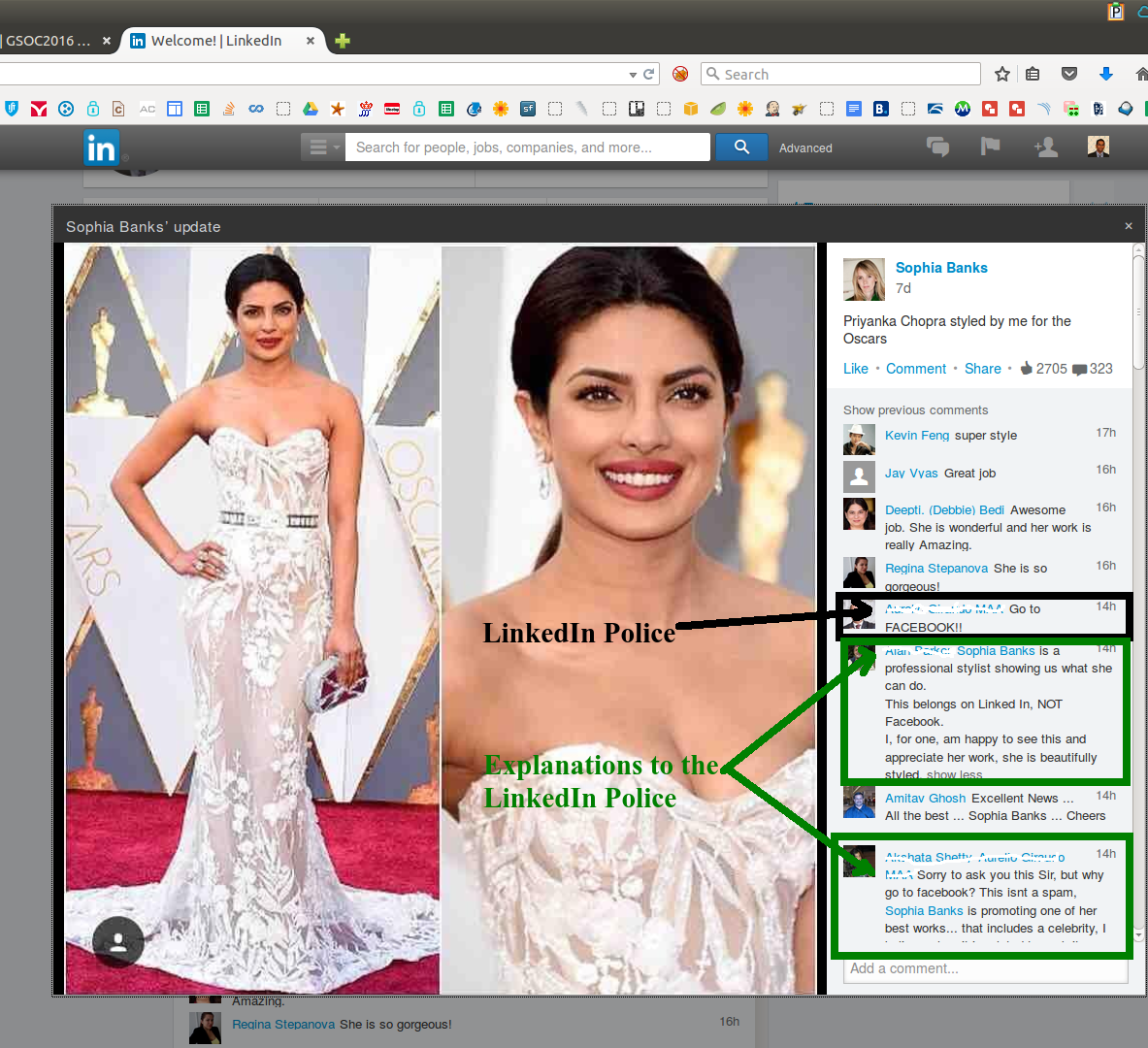
A LinkedIn Police trying to advice what is LinkedIn.
There are so many annoying users in LinkedIn. The worst of all falls into the category called "LinkedIn Police". Why are they worst? Because, first they think they are smart, while being apparently oblivious from how LinkedIn or any social media works. Second they attempt to control others in LinkedIn, and by doing so in fact they contribute to the content that they do not really support. The commonest mantra of the LinkedIn Police is, "This does not belong to LinkedIn". They also have another: "Please go to Facebook".

While I hate spammers, I dislike the LinkedIn Police more, as either they contribute more to the spam, or they just create flame wards due to their ignorance and interest in controlling other users. For instance, one's entertainment is another one's entertainment or random topic. So next time, before being the LinkedIn Police, try to be nice. If you really want to combat the spam, use the best of all strategy: ignore.

In the image: A member of the LinkedIn Police seems to educate what is allowed on LinkedIn. However, other members of the LinkedIn community were quick to note that this indeed belongs to LinkedIn as this is what the job of the poster - a stylist.

If you are not sure, being a LinkedIn Police does not help your career. It is worse than the spammers, if you would ask me.

I do not of course support random guys and girls adding cute selfies to LinkedIn. But unless you guys communicate with them even by commenting negatively, these images or irrelevant content won't spread as viral content. Also please do not forget that stylists and models are professionals too. Respect their choice of posting their work or sample (which may look like a "Facebook content" for you, while it is not). Overall, just be nice to strangers.